Why are some of the ancient Egyptian statues black?


The statues of ancient Egypt were made of different kinds of stone; the choice of stone was based not only on practicality but also on availability, purpose, durability, and appearance. Hard, dark stones convey permanence and prestige, while light limestone and sandstone are the easiest to form, which is why they are used for temples and sculpture.
What are the different kinds of materials used and why?

Granite—especially red or pink granite from Aswan;
used for large statues, obelisks, sarcophagi,
and architectural elements.
Diorite—extremely hard, dark stone used for important royal statues, including famous representations of Khafre.
Basalt – dark volcanic stone, often used for statues, floors and ritual objects.
Quartzite—a very hard reddish or brownish stone, used extensively for royal statues and temple sculpture.
Limestone—one of the most common materials, especially for statues and reliefs in northern and central Egypt.
Sandstone – widely used in temples and statues, particularly in Upper Egypt.
Alabaster (Egyptian calcite) – translucent white or creamy stone, used for statues, vessels and ritual objects.

The statue of Psamtikseneb, carved from solid schist rock Greywacke – a dark, fine-grained stone used for high-quality sculptures.
Schist – particularly important for early masterpieces such as the Narmer Palette.
The color black (KEM) carried positive sacred and religious meanings, so when you see the statue is covered in black, this could be for three main reasons:
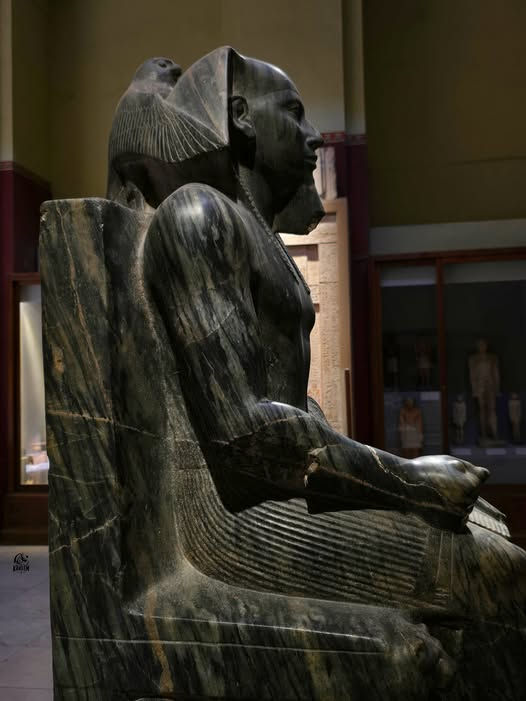
1- The choice of black precious material like granite, schist, or Basalt. These volcanic rocks are not easy to carve, so they send a message of well-being and wealth. Also, the hard materials symbolize immortality and endurance.
2- Sacred religious symbolism: resurrection, rebirth, and the River Nile.

A- The dark silt of the Nile that brings fertility to all Egypt, the absolute source of life to the whole valley.
B- The connection to Osiris, the (NETR) (God) to the underworld. That’s why the statues of the ka (spirit) are always covered and painted in black. E.g., the two statues of Tutankhamun as well as the famous statue of Nebhepetre Mentuhotep II in the Egyptian Museum.
3- Environmental decay and aging
In some cases, statues that looked black didn’t look like that when they were first made. But some elements they were exposed to turned them this way: smog
oil, bats, pollution, rain, and funerary objects.

Want to learn more about colours and their significance in Ancient Egypt?
Subscribe to Moshytours.com or contact us to dig deeper into Egyptian history with Moshy the Egyptologist. WhatsApp +201066216511


Comments